
I've been involved in church my entire life. Over the years, I've heard thousands of sermons, many of them built around particular topics, supported by selected biblical texts.
I've learned a great deal from those sermons. Looking back, though, I've noticed something interesting. Certain familiar biblical passages were referenced repeatedly, other passages were referenced seldomly, if at all. Further, among the passages pastors cited frequently, often parts of their surrounding passages received comparatively little attention.
Consider the book of Ruth.
I've often heard quoted Ruth's remarkable declaration of commitment. I've heard messages about Boaz's character and his role as a family redeemer. But I can scarcely recall a sermon that paid close attention to Naomi—particularly the conversation she has with her daughters-in-law before Ruth makes her famous declaration.
A few years ago, as I began examining that conversation more closely, I discovered questions I'd never thought to ask. That experience made me consider a bigger picture question:
What becomes possible when we move beyond recognizing familiar statements and begin observing how a passage's elements relate to each other?
That question isn't limited to reading Scripture. It touches on a distinction researchers have observed in the ways people read: finding particular information in a text and developing an understanding of how that information fits together are not necessarily the same mental activity.
What Researchers Discovered About the Ways We Read
Imagine sitting in front of a computer screen, reading an unfamiliar text. As you read, a device tracks your eye movements, recording where you look and how your attention moves between different parts of the material. That's what a group of Chinese researchers did in a 2024 study involving 24 university students. The students completed two kinds of reading tasks. Some tasks required students to locate specific facts within the content. Others required them to develop an understanding of the text's content.
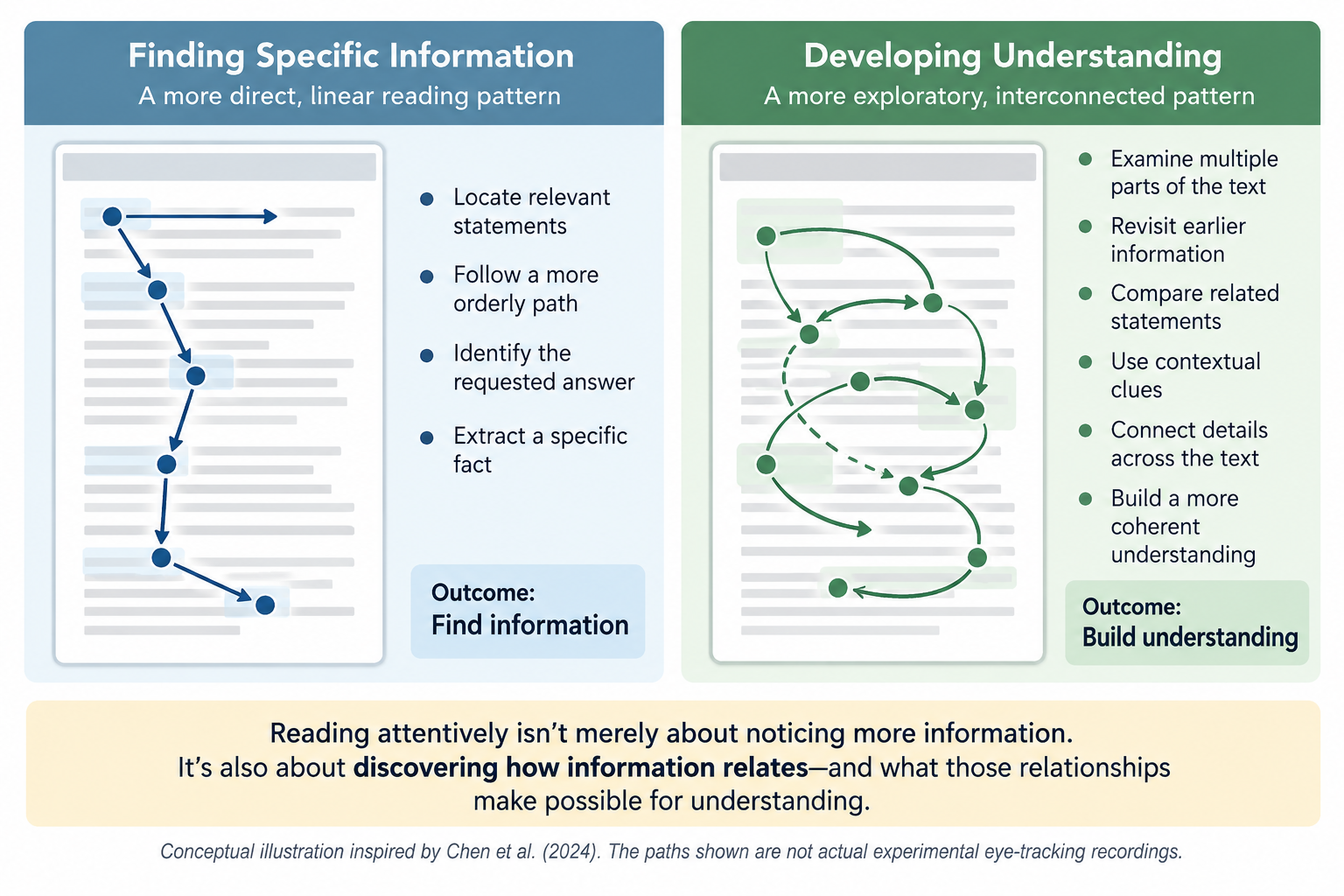
The researchers discovered an intriguing difference. Readers who focused on finding information relevant to their tasks employed a variety of strategies. They located information, evaluated its relevance, used contextual clues, navigated between sections, and brought information together.
But readers' approaches varied depending on what they were trying to accomplish. When searching for specific facts, attentive readers tended to follow a relatively orderly, linear progression. When working to understand content, their patterns became more exploratory—sometimes spiral-like—as they navigated and connected information.
The researchers' findings illustrate an important distinction:
Finding information in a text is not necessarily the same as understanding how that information fits together.
Seeing More Than Individual Statements
Consider how this distinction applies to reading the Bible. We can identify the people, events, and important statements in a passage without necessarily recognizing how those elements relate to one another.
But when we follow the relationships between statements—how one statement leads to another, how an argument develops, or how a person's response changes the direction of a conversation—we may begin asking questions that never occurred to us before.
That was my experience when I began paying closer attention to Naomi. We often remember Ruth's extraordinary declaration of commitment. But what about the conversation that led to it?
Before Ruth speaks those memorable words, Naomi has already made a sustained argument, urging her daughters-in-law to return home.
What might we discover if we followed Naomi's argument from beginning to end, rather than moving directly to Ruth's familiar response?
Let's return to Ruth 1:6–18 and find out.
A Familiar Conversation
Ruth chapter 1 contains one of the Bible's most memorable declarations of commitment. Naomi has lost her husband and both sons while living in Moab. When she hears that ADONAI has provided food for his people in Judah, she prepares to return home, accompanied by her two daughters-in-law, Orpah and Ruth.
Along the way, Naomi urges both women to return to their families. Eventually, Orpah does. Ruth refuses. We remember Ruth's declaration: "Your people will be my people, and your God will be my God."
But before Ruth speaks those familiar words, the writer records an extended conversation.
Let's read Ruth 1:6–18 twice, each time with a different goal.
First Reading: What Happened?
Read the passage as you normally would.
As you read, consider three questions:
- What does Naomi want her daughters-in-law to do?
- What does Orpah eventually decide?
- What does Ruth decide?
These questions help us identify important information. We can answer all three without much difficulty.
But now, let's return to the passage with a different question.
Second Reading: How Does the Conversation Develop?
This time, pay particular attention to Naomi.
Notice that the narrator first describes all three women beginning the journey toward Judah. Immediately afterward, Naomi urges her daughters-in-law to turn back.
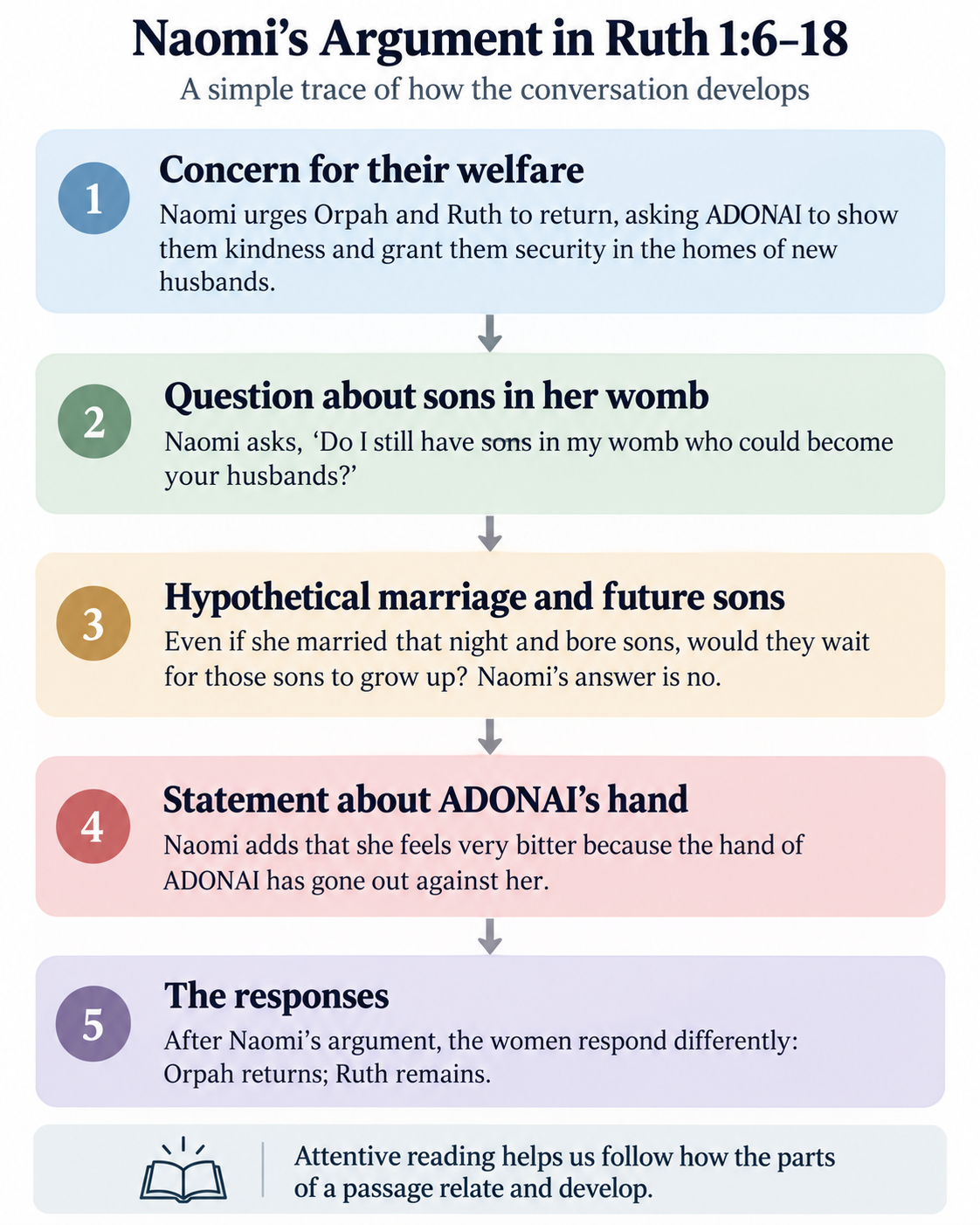
She asks ADONAI to show them kindness and grant them security in the homes of new husbands.
Both Orpah and Ruth initially refuse.
So Naomi continues attempting to persuade them. She asks them to consider whether she still has sons in her womb who could grow up and become their husbands. The expected answer is no.
She explains that she is too old to marry. Then she imagines an unlikely possibility: What if she could marry that very night and bear sons? Would Orpah and Ruth wait for those sons to grow up? Would they remain unmarried for years in the meantime? Again, the expected answer is no.
Notice what's happening. Naomi isn't simply repeating her instruction to return. She is developing an argument. She moves from concern for the women's future security to the practical impossibility of providing them with husbands through sons of her own.
And then she says something more.
A Statement Worth Considering
After completing her argument about the impossibility of husbands for them coming from her, Naomi adds:
"On your behalf I feel very bitter that the hand of ADONAI has gone out against me." (Ruth 1:13)
Notice where this statement appears. It comes at the conclusion of Naomi's extended reasoning.
Immediately afterward, both women weep again. Orpah kisses Naomi goodbye, while Ruth clings to her.
Now we have a question that invites exploration.
Is Naomi offering one final reason for both women to leave, or does her statement concerning ADONAI reveal something about how she understands the circumstances that have shaped her argument from the beginning? (Or both?)
And another question follows: Might Naomi's statement have influenced Orpah's decision to return?
The narrator doesn't tell us what Orpah was thinking.
But notice how following Naomi's argument has brought us to questions we might not have asked if we'd focused our attention directly on Ruth's familiar declaration.
And What About Ruth?
After Orpah returns to Moab, Naomi makes one final appeal to Ruth. She points out that Orpah has returned to her people and her god, then urges Ruth to follow her.
But Ruth responds differently. Rather than explaining how Naomi might obtain a husband or overcome the practical difficulties she has described, Ruth declares her determination to remain with her.
She commits herself to Naomi's people and Naomi's God, and to living, dying, and being buried where Naomi would.
When Naomi recognizes Ruth's determination, she stops urging her to return to Moab.
Notice the contrast. Until Ruth spoke, Naomi previously dominated the conversation. The writer describes no one other than Naomi directly speaking . . . until Ruth speaks. Naomi spent her energy explaining why accompanying her offered little apparent prospects of security through her family.
Ruth's response does not attempt to solve those difficulties. Instead, she expresses an enduring commitment in spite of them.
What Did the Second Reading Make Possible?
Think back to the questions from our first reading. We identified what Naomi wanted, what Orpah decided, and what Ruth chose to do.
Those observations were correct. But our second reading gave us more to consider. We followed how Naomi's argument developed. We observed how her rhetorical questions supported her reasoning. We noticed where her statement about ADONAI appeared and how the women's responses followed.
And we encountered questions about Naomi's understanding of her circumstances that might not have occurred to us otherwise. We haven't answered every question. We don't need to yet.
For now, our important discovery is that how statements in a biblical passage relate to each other can reveal dimensions of communication that its individual statements, considered separately, may not disclose.
That's one of the possibilities intentional and attentive reading opens to us.
Discover Your Reading Barriers
Continue reading with me
I share articles and practical exercises for attentive Bible reading on Substack. Subscribe there if you’d like future posts delivered to your inbox.
Chen, J., Zhang, L., & Lu, Q. (2024). How readers attentive and inattentive to task-related information scan: An eyetracking study. Data and Information Management, 8(4), Article 100073.